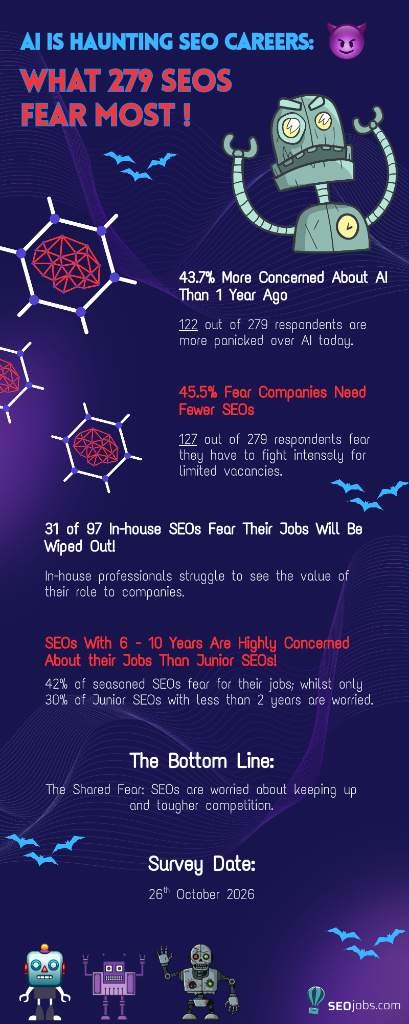






122 of 279 SEO and search professionals say they are more concerned about AI than they were a year ago. The shared fear is a smaller team and a faster set of tools. This study breaks that fear apart by job, experience, and country.
One in three is already very afraid
Asked how concerned they are that AI could hurt their job or income within two years, slightly concerned was the single largest answer. Very and extremely concerned together are 92 people.“Extremely concerned” alone is 25 of 279, or 9.0%. The fear headline uses very and extremely together.
The fear is higher than it was last year
Compared with 12 months ago, 122 people are more concerned, 91 feel about the same, and 66 are less concerned. Inside the “more” group, 51 are much more concerned and 71 are slightly more concerned.The fear is a smaller team, not a deleted job
People could name up to two changes they fear. The bars are the share of all 279 who selected each option, so they are not meant to add to 100%.42 people also wrote in their own answer. Two of those lines:
“Selling my role’s value to higher ups if they think SEO is going away.” In-house, 11–15 years
“Google/AI will essentially kill traditional search and competition, killing many businesses rather than actual SEO jobs.” Business owner, 16+ years
The fear changes with the job
High concern means very or extremely concerned. Job seekers are the most afraid group in the survey. The group is 18 people, so the count stays next to the percentage.In-house SEOs are the most afraid the role itself disappears
31 of 97 named role elimination, the highest share among people who have a job. Keeping up and tougher competition are tied just above that, at 45 of 97.Agency SEOs are afraid the team shrinks, starting with junior seats
43 of 85 named smaller teams. 28 of 85 named entry-level roles disappearing, the highest of any work situation. Only 6 of 85 said they were not particularly concerned.Owners are afraid they cannot keep up
14 of 20 named the pace of AI. That is a different fear from losing a seat. Pay pressure is 4 of 20. None of the owners named the entry-level pipeline.People looking for work are afraid of the market, not a role they no longer have
11 of 18 named smaller teams, and 11 of 18 named tougher competition. Role elimination is 2 of 18. 13 of 18 are more concerned than a year ago. None checked “not particularly concerned.”Consultants are the least rattled, and pay is not their top fear
12 of 59 checked “not particularly concerned,” the highest share of any group. Smaller teams is still the top selection, at 23 of 59. Pay or rate pressure is tied with keeping up and competition at 20 of 59.Mid-career is where the fear of being cut peaks
People with 6–10 years in search are the most likely to be highly concerned, and the most likely to name role elimination. The 11–15 year group is the most likely to say current skills will lose value. Veterans name elimination least often. Their lead worry is keeping up.For the 16+ group, 16 of 90 checked the separate box “I’m not particularly concerned.” On the five-point scale, “not concerned at all” is 17 of 90. For the 11–15 group, that checkbox is 5 of 90, while “not concerned at all” on the scale is 12 of 90. Keeping up is the top named worry for veterans: 42 of 90.
In the U.K., the fear is already hotter. In the U.S., the fear is the other candidates.
17 of 38 people in the United Kingdom are very or extremely concerned, against 43 of 154 in the United States. The rise over the past year is similar: 63 of 154 in the U.S. and 15 of 38 in the U.K. say they are more concerned than 12 months ago. The named fear splits. In the U.S., tougher competition leads, at 73 of 154, ahead of smaller teams at 67 of 154. In the U.K., keeping up leads at 17 of 38, and role elimination is 12 of 38. Competition is 10 of 38.Germany is the most afraid market in this sample: 15 of 21 are very or extremely concerned, and 11 of 21 are much more concerned than a year ago. Canada’s fear is the pace, not the seat: 0 of 23 named role elimination, and 14 of 23 named keeping up. In India, 3 of 17 are highly concerned now, and 9 of 17 are more concerned than a year ago. Spain was 12 people and is not charted.
What the splits suggest
In-house
The fear to answer is that the seat goes away. 31 of 97 already think the role could be eliminated.Agency
The fear is a smaller team, and the junior rung is part of it. 28 of 85 think entry-level roles disappear.Owners
14 of 20 are afraid of the pace. They need a practical way to keep up, not a lecture on job loss.6–15 years
This is where people fear being cut or having their skills discounted. It is the group to train first.What industry leaders say
Four practitioners on what the fear means, and what to do next.
“5 Must-have SEO hard skills for the GEO Era.”
- Marketing. Learning marketing beyond just SEO. SEO is no longer just Google and having knowledge beyond that will help immensely.
- Personal Brand. Building a personal brand to stand out more in the hiring process and lead to additional job opportunities.
- Crawl Logs. They don’t get enough love, but they’re the only source of truth. GSC only gives you Google crawl stats and they’re limited. You need a full view of how bots are crawling your site.
- Mastery of AI. Those SEOs who use AI to speed up low-level or non-important work, will shine having more time to focus on what actually makes money.
- Technical SEO. Beyond just Crawl logs, I feel Tech SEO is finally becoming important again. SEOs should learn more about JS SEO, crawlability, crawl depth, internal linking and indexability.

“It’s not surprising to see the fear of AI increasing as the models are getting better, alongside the amount of mass redundancies we’re seeing in tech and marketing across the globe. I don’t see AI replacing teams though, I see it enhancing their output and efficiency. The shift for SEO’s will be moving from just execution into bigger picture thinking, strategy, relationship building and creativity. It gives us more freedom to get things done faster – it doesn’t need to replace the human behind it.”

“SEOs in the UK who are doing well right now possess two important skills. First, they can explain the impact of their SEO and how it translates into revenue. They know their margins, their best sellers and category pages worth targeting. They use AI to complete the grunt work and spend more time on strategy. Second, they improve on personal branding by sharing what they learned in public and forge strong relationships outside of their current drop. The fear drops fast when your income does not hang on one job title.”

“The finding that stands out to me is that mid-career and in-house SEOs are the most worried. That’s exactly the group that has the most context about their business, which is the one thing AI can’t copy. I see this with my clients: the in-house people who keep their seat are the ones who stopped reporting on rankings and started explaining what AI search means for revenue. If you’re worried, learn the tools, but more importantly get closer to the business.”